What determines when we sleep? What determines how long we sleep for?
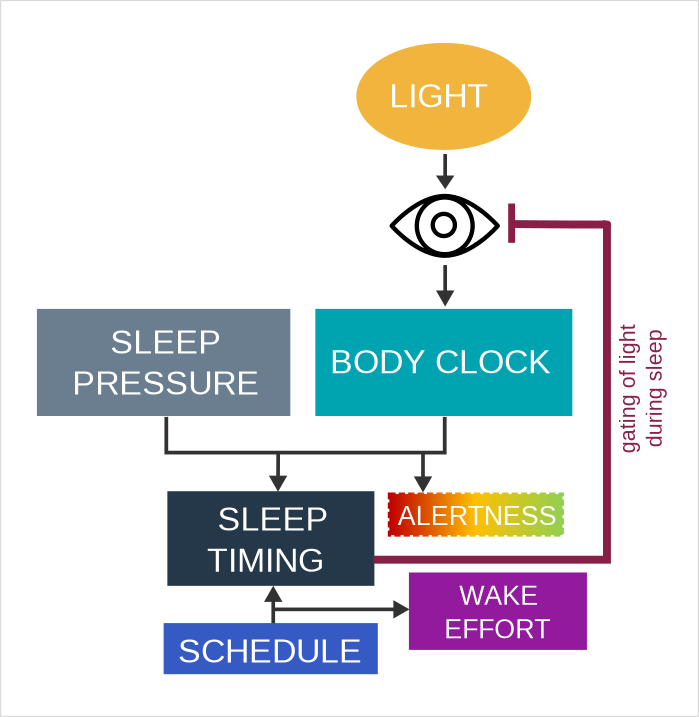
If we had no constraints on our sleep, our bed- and rise times would result from the interplay of two factors: a homeostatic 'sleep pressure' factor and
a clock-like 'circadian' factor.
Sleep pressure builds up while we are awake and dissipates while we are asleep.
Our bodies have a circadian clock that keeps track of time-of-day, synchronised to the 24-h day by time cues like the environmental light/dark cycle.
For most of us though, our time in bed is limited by family, social and work commitments. These scheduling constraints can conflict with our preferred bedtimes and can leave
us feeling tired and unproductive.
How do we make predictions about your sleep timing?
We use mathematical models that describe how each of these factors affect the time we spend asleep.
The Science of Sleep Timing
The Two-Process Model
The two-process model is foundational to many mathematical models of sleep. Developed by Borbély, Daan and Beersma in the 1980s, it describes the interaction of circadian rhythmicity with homeostatic sleep pressure. The interactive tool below, adapted from Skeldon & Dijk 2025, simulates the two-process model. Each slider represents a different model parameter. Once both boxes are green, click 'simulate the two-process model' to solve the model.
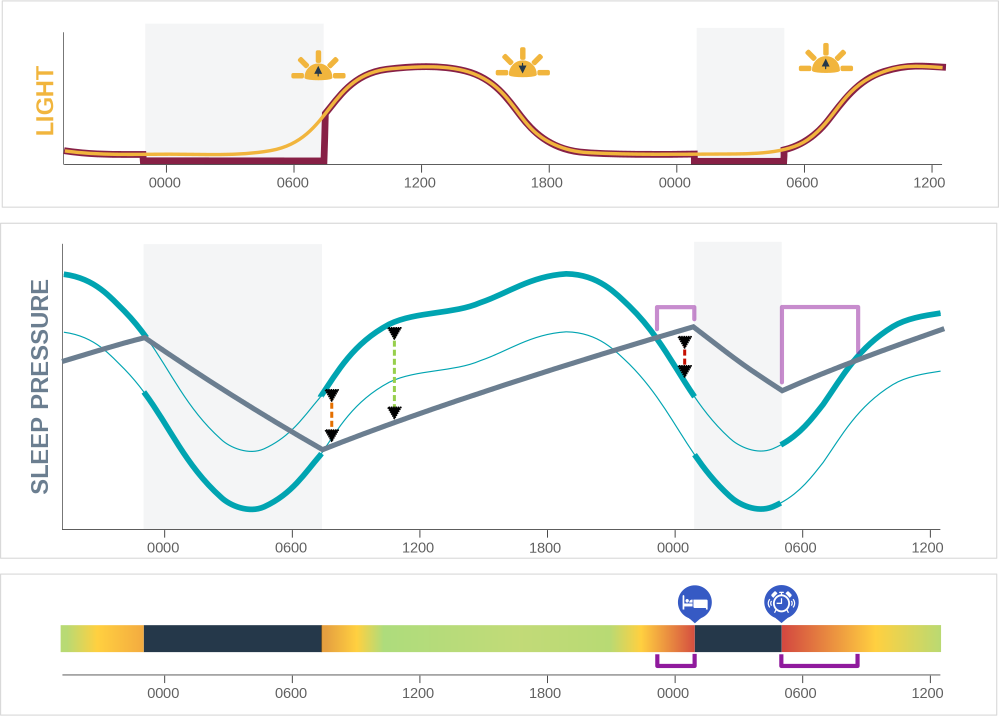
The Homeostatic-Circadian-Light Model
In the two-process model, the circadian drive 'free runs' - it is not synchronised with the 24-h day. Light is the most powerful synchroniser of our circadian rhythms. The homeostatic-circadian-light model extends the two-process model by including the effect of light.